Plan B is a soul artist of sorts, what I mean by this is that he mixes soul with other genres in order to create a fusion. However his song "Prayin" is definately of the soul genre, we know this due to the sound that we hear. The non-diagetic sound that is provided, this comes in the form of a brass band, these are a key trait of soul music. Also the way he sings is very expressive we can tell this from the tone of his voice and the desparation that he clearly puts across in his lip synching. However as the sound that is diagetic is only the singing it shows how Plan B is a solo artist rather than part of a larger group it could also show how alone he feels during this video as the song is about guilt for killing another man this idea seems to fit well.
The mise-en-scene for this video is a lot more aggressive than other soul artists whos songs and mise-en-scene are a lott calmer and more romantic. This emphasises Plan B's very individual image, as he originated in rap (a traditionally agressive genre) that shows in his mise -en-scene (see above.) Also the fact that the video is set in prison shows a darker side to his music which connotes his very grimey up bringing in London. However his clothes suit the trend for soul artists, this is due to the fact that most male artists wear smart clothing such as suits, as we can see (again above) Plan B conformes to this one stereotype of his genre.
The cinematography in Plan B's video is very in keeping with the style of a rap video, in fact it has very little in common with most soul videos, for instance above there is a clip of Plan B's "Prayin" video, as we can see the shots are handheld, this connotes that he has so much emotion that he cannot control it, this is similar to a soul video. However, the close ups and high mobility in the shots connote a very angry theme to the video, this shows Plan B's rap background. The close ups could however connote that this is a very personal video as its almost like Plan B's own confession which is obviously a very personal affair. The editing colates with the cinematography very well as the montage editing creates a very confused atmosphere which emphasises the angry/upset mood that is clearly very evident in this scene.
Lemar is a classic Soul singer, he has a lot of passion that he freely and openly shares on stage, this passion is clearly shown in his video for the song "It's not that easy". Lemar's mise-en-scene is clearly shown in the video as he wears his trademark suit and tie combination and uses the classic 50's style microphone. These 2 items clearly state him out to be a soul singer as the suit is common for male soul artists across the board, and the microphone refers to the golden age of soul, the 50's. The clothes he wears also make him very approachable as he looks to be a gentleman, this fits him as he is often reffered to as one of the "gentlemen of pop", which reflects his mise-en-scene of the "nice guy".
The sound in this video is dominated by diagetic sound as Lemar and the band make up the music, this shows how his music is very "real" and has not been interfeared with (autotuning) as we can see the band playing the music (for the most part.) The moments of non-diagetic sound emphasise the singers isolation as he is alone and the music has almost abandoned him along with everything else, this is shown by the absense of the band.
The cinematography in this video shows how Lemar's emotons are increasing, this is clear as the camera comes closer to the singer as the shot progresses, this could show how Lemar's emotions are intensifying. It also makes the performance more personal to the viewer as they have an up close and personal view of the performer, this enables the song to have a greater effect due to the fact that the viewer can clearly see the emotion on the singers face. The editing here is clearly continuous as the shot is about 10 seconds long, this could show the singers long suffering or the everlasting love he possesses for the woman he is singing to.
My group for A2 media have decided we'd like to make a music video for the pop-soul genre (artists such as Duffy, Plan B, Adele, Seal, Jamie Cullum etc)...
Duffy's video for 'Rain on Your Parade' is very conventional to the Soul genre. The colour scheme (black/grey/white) is consistent throughout which is a typical colour scheme in itself to the genre which tends not to use bright, garish colours and prefers to give an impression of 'class' and subtlety. These choices in colour may be in place to represent the differences between genres such as chart pop and soul, to show how soul music isn't manufactured and the artists care about music more than image. In most cases, female soul singers appear classy, glamorous and well-dressed however, in this particular video Duffy is dressed moderately provocatively. Despite this, Duffy's state of dress still comes across to the viewer as quite smart, she wears a black blazer and tights and has sex appeal but doesn't look cheap unlike some r'n'b artist, no real inappropriate skin is shown.
In terms of performance, Duffy's role in the video is bold but simple, she sticks to basic but effective dance moves (as shown in the gif image attached below) which is conventional to the genre which doesn't rely on dance moves in music videos and hasn't done even since the real beginning of soul/motown music (as shown by The Supremes in the gif image attached to the right). Instead, Duffy uses male dancers to compliment her own simple dance routine with a more complex one and to avoid viewer fatigue and the technique is effortlessly effective. The dancer's costumes are also smart, the men wear suits and jackets which is again very conventional dress for men in the soul genre including artists and dancers. The male dancer's routine (below) revolves around the main artist and they are seen to be 'falling' around her which suggests her status and importance as an independant and strong woman which is an attitude often adopted by females of the soul genre.
Cinematography is fairly simple throughout, ranging mainly between close ups and long shots which is conventional to music videos (particularly for solo artists) which tend to show the artist performing/singing the song then long full body shots to show dance moves. This is really effective because it presents Duffy as the main focus for the video, which is also portrayed by the fact that she is the only female and that the colour of her legs stand out against the black of the dancer's costumes. The camera movement depends a lot on tracking the artist, which again conveys her to be the main attraction and connotes her to be a strong woman as everything revolves around her (which is conventional to female artists in the soul genre). The camera movement is very smooth (demonstrated in the above image) and fits in well with the smooth, jazzy feel of the music.
Lighting is key to this video, despite the setting being a plain room, the lighting turns it from dark to light in an instant which creates the idea of changing setting to the viewer and thus avoids fatigue. The lighting is also used to create sillhouettes and at times (again demonstrated above) is used as a vehicle to make Duffy stand out and the dancer's to appear sillhouetted. This is a typical lighting style of the music video, which is a promotional tool and uses lighting to flatter the artist - in order to create sex appeal and sell records. As a viewer, we also see a lot of sillhouetted instrumentists, this is conventional to the soul genre in particular as the instrumentation is key to convey that this genre isn't manufactured and the artist is passionate about music moreso than image, which is more important to pop chart artists.
The editing is also fairly simple which is conventional to a music video which tends to run as a narrative with occasional cuts to performance based shots. However, in the clip above I have included a jump cut which moves from a shot of Duffy central to the frame in a long shot, to a mid shot. Her stance is strong, hands by her sides and legs apart, dominating the frame and the lighting makes her appear a sillhouette. This creates a sense of strength and mystery which again are both conventional to the genre as strong women are prominent in soul as I've previously stated and this eludes to the fact that women in soul tend to be more mysterious than those in pop as they don't so much reveal their personal lives to glossy magazines etc... The shot rotation throughout is fast and fluent to avoid viewer fatigue, although this slows down when the dance routine begins as this allows the viewer to focus.
This is a short commentary I made on the video, please excuse my voice I had a cold.
Amy Winehouse's video for 'You Know I'm No Good' fits some of the conventions for a soul genre video, however much alike herself, certain aspects do contradict the 'norm' in terms of soul music videos but it works as a promotional tool nonetheless.
In terms of lighting, Winehouse's video is really effective and conventional to soul. In the example (below) low key, but highly effective lighting is used on a dark background, reminiscent of a Duffy video, which not only flatters the artist but increases their status and in this case creates an 'eerie' feel. This use of bright lighting on dark background is evident in a lot of soul music videos and could definitely be considered typical of the genre.
In this video Amy is dressed in her typical 'scruffy' style, messy beehive and vest top despite the conventional dress for a female soul singer being usually quite the opposite, dark, smart clothing (such as a black dress). However, Winehouse's own development of fashion earned her recognition as a household name and figure, her sense of style is recognised both world and nationwide. Therefore, although she doesn't really conform to the fashions set by previous soul singers, this helped her to create her own success as an artist and an individual.
The location throughout the video is strikingly similar, although props change around the dark room, such as a bar, a table, a bath, a bed (pictured below). This prop rotation allows the room to take on the shape of a new setting and avoid viewer fatigue.
The colour scheme is dark and revolves around a blue/white/black/grey basis which is highly typical of a soul genre video, particularly in female soul artists. Soul singers tend not to use garish colours and sex-appeal image to sell music but focus more on the message of the music.
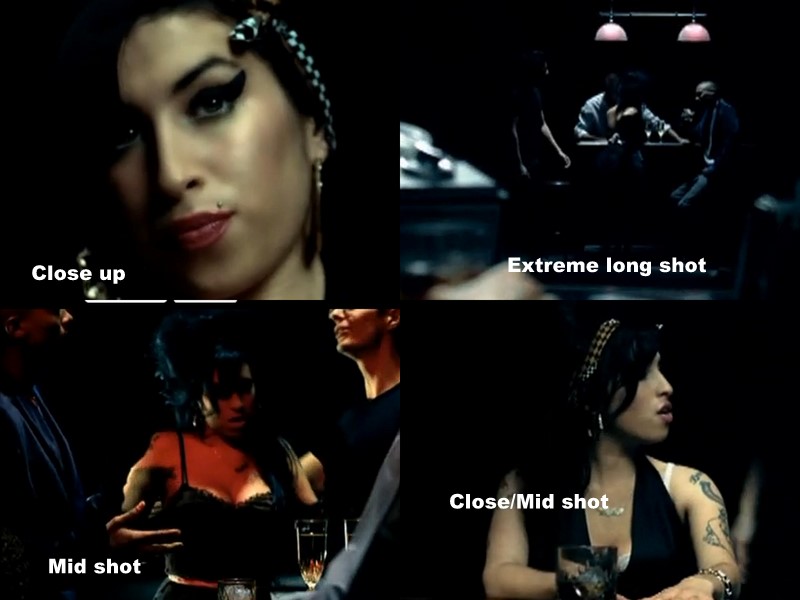
Unconventional use of shot types.
Despite the 'lack'of real location change or at least dramatic location change, the video is extremely effective due to it's clever use of cinematography. Winehouse's video is unconventional to the average music video in that a wide variety of shot types are used whereas a music video normally stays around the long shot/close up area, this helps to introduce the viewer to and sell the artist. However, Amy's creative influence in clear in this instance, as is the soul genre, a focus is set more on the message of the song and conveying this in a narrative structure rather than by creating a video revolving around how the artist is important, sexy, etc...
As well as this, a creative, but unconformist decision has been made using cinematography, in that the video uses the highly rare over the shoulder shot in music video format. This is a shot type usually avoided by a music video director as it completely shuts off the artist from the viewer in that their face is not visible, but the back of their head which is often considered a sign of rudeness in day-to-day situations. This would be considered ineffective as the viewer is supposed to engage with the artist in a way that would make them want to buy their music after watching their video. This represents how Amy Winehouse was more interested in her music, than image, or money, fame and beauty (which is further shown in her less than glamorous state of dress) although this isn't typical of a music video this is a trait often portrayed in the soul genre.
Evidence of media and alcohol cultures in the video
The editing throughout on a general basis is typical to a music video structure, moderately fast shot rotation and a mixture between narrative shots and performance based scenes. However, what I found particularly interesting was the way editing is used to show Amy watching her own actions on television and in moving polaroid 'photographs', I found these scenes particularly poignant as they connoted her own struggles with the media and the media insistence on documenting her 'fall from grace' at any given opportunity so all were aware of her personal issues and dramas. As well as this was the dominance of alcohol throughout the video, which I also found intriguing as Amy's creative influence upon the video becomes evident, connotations of her personal battles with alcohol and drug abuse whilst being questioned by a love interest, representing her rocky relationship with husband, Blake for which the whole album 'Back to Black' was based upon add an essence of personality to the video. These connotations show how Amy was passionate about her music, how these lyrics meant something to her and how she wanted to represent this in the video and make it more personal to her - something, maybe not to such extremes, which isn't rare in the soul music genre which is known to focus on music, not image.
Off centre shot, represents her personal state and her unconventionalism
Island records was founded in Jamaica but was based primarily in the UK for many years, now it's owned by the Universal Music Group however now it operates under the Island Def Jam Motown Music Group. This fits well with soul as soul as a genre is derived from Motown which came about in 1960s Detroit, as well as this Def Jam records is well-known for the making of accomplished r'n'b and hip hop artists such as Rihanna - which are also genres of black origin. However, nowadays soul music is equally as dominated by white artists especially in Britain.
Artists such as Leona Lewis, Lionel Richie and most relevant to our genre of female soul, Amy Winehouse are signed to Island Records.
The fact that Island records is related to soul artists means that they're a relevant record company to our planned artist as we wish to base our portfolio around soul music.
WARNER MUSIC GROUP: is the record label that I have chosen to discuss in this blog post. This is because it best supports the genre of music that I intend to use to create my own music video.
This is the third largest business group and family of record labels in the recording industry, making it one of the big four record companies.
This company was formed in 2004 when it was spun off and made completely seperate from Time Warner.
Some artists that work with Warner Music Group are the likes of: Chaka Khan, Seal, Simply Red and Rod Stewart. This sing in the same style as my choice of artist Duffy.
Warner Music Group is currently situated in New York, United States. This is a very beneficial place to be as there are always new artists looking for recognition in America and being situated in New York would be ideal for the artists to find the record label and want to work with them.
Columbia records started up in Washington D.C in 1891, from then to know a lot has changed (believe it or not) and it has since become a very successful record label for soul artists. It is owned by the Japanese company "Sony Entertainment". This is a big label and therefore a lot of very successful artists have been attracted to it because of that.
I think that this label would suit our music video due to the fact that they sign on a lot of british artists (like Adele for instance) and a lot of artists who fit into the catagory of soul artists (Adele and Beyonce pictured above.) However it is an American label which might make it a bit less relevant to the type of artist that we need to emulate.

 The mise-en-scene for this video is a lot more aggressive than other soul artists whos songs and mise-en-scene are a lott calmer and more romantic. This emphasises Plan B's very individual image, as he originated in rap (a traditionally agressive genre) that shows in his mise -en-scene (see above.) Also the fact that the video is set in prison shows a darker side to his music which connotes his very grimey up bringing in London. However his clothes suit the trend for soul artists, this is due to the fact that most male artists wear smart clothing such as suits, as we can see (again above) Plan B conformes to this one stereotype of his genre.